Sonic Adventure – Review
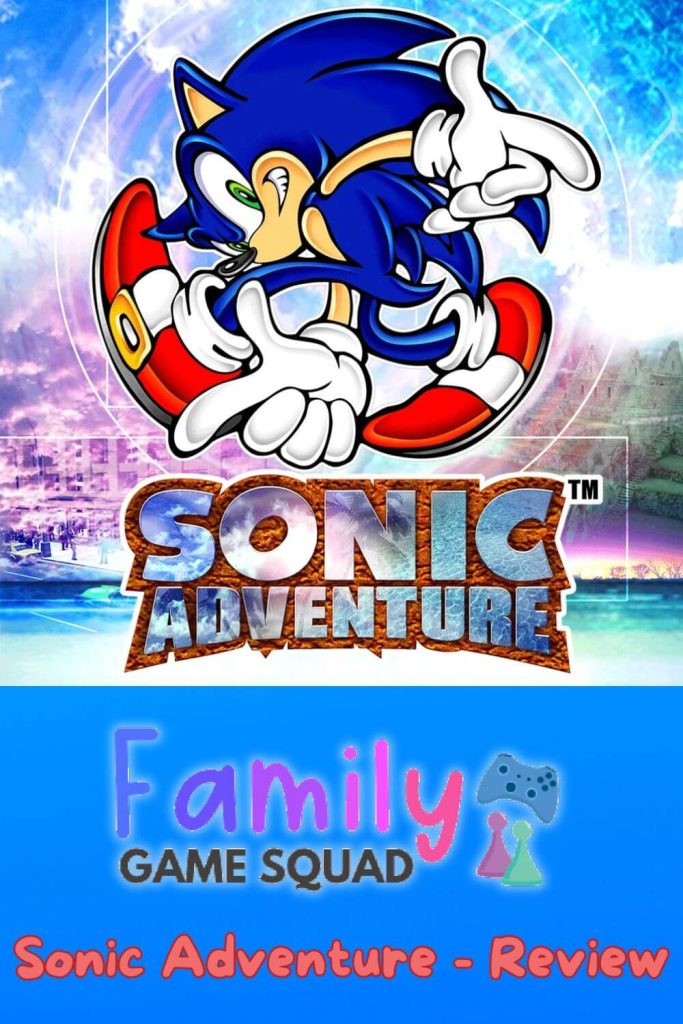
Sonic Adventure is one of the most important games in the history of the Sonic series. It marked the transition of Sonic the Hedgehog from 2D side-scrolling gameplay into a fully 3D world. We love playing it and the Chao Garden section as well. We have the DX version and in my review you’ll find out more.
Why Sonic Adventure?
Released originally for the Sega Dreamcast, the game introduced new mechanics, multiple playable characters, and a more cinematic storytelling approach.
The story begins when a mysterious water-like creature named Chaos is released by the villainous Dr. Eggman. Eggman plans to use Chaos and the power of the Chaos Emeralds to take over the world. Sonic and his friends must stop him before Chaos becomes too powerful.
Sonic Adventure DX: Director’s Cut is an expanded version of the original Sonic Adventure, bringing one of Sonic the Hedgehog’s first 3D adventures to a wider audience. Originally released on the Sega Dreamcast, this updated version adds new features, improved visuals (for its time), and extra content.
One of the most notable features of the game is its multiple playable characters, each offering a different gameplay experience. Players can take control of Sonic the Hedgehog, Miles “Tails” Prower, Knuckles the Echidna, Amy Rose, Big the Cat, and E-102 Gamma. Each character has their own storyline that connects to the main plot, giving players different perspectives on the events.
Sonic’s gameplay focuses on speed and platforming. His levels are large and designed for fast movement, featuring loops, ramps, and multiple pathways. These stages aim to recreate the fast-paced feel of the classic 2D games in a 3D environment.

Tails offers a racing-style gameplay, where players compete against Sonic to reach the end of levels. Knuckles focuses on exploration, searching for hidden pieces of the Master Emerald in large open areas. Amy’s gameplay involves escaping from danger while solving light puzzles. Gamma introduces shooting mechanics, while Big the Cat has a slower-paced fishing gameplay style.
This variety was ambitious and helped make the game feel larger and more dynamic. Each character’s story adds new details, and completing all of them unlocks the final part of the game’s story.
Another major feature is the hub world system. Players explore areas like Station Square and Mystic Ruins to find entrances to levels and progress the story. This design adds a sense of adventure and makes the world feel more connected compared to simple level selection menus.
The game also introduced the Chao Garden, where players can raise small creatures called Chao. This mode allows players to care for, train, and interact with their Chao, which can later participate in races. It adds a relaxing side activity that contrasts with the action-focused main gameplay.
Visually, the game was impressive for its time. The environments are colorful and varied, including cities, jungles, and ancient ruins. Character designs were updated to fit a more modern and detailed 3D style.
The music is another standout feature. The soundtrack includes energetic rock songs, character themes, and atmospheric tracks that help bring each area to life. Many of the songs are memorable and closely associated with the Sonic series.
However, the game does have some weaknesses.
The camera system can be difficult to manage, especially during fast sections or precise platforming. This can sometimes lead to missed jumps or confusion about where to go.
Not all gameplay styles are equally enjoyable. While Sonic’s levels are often the most exciting, other characters—particularly Big the Cat—may feel slower or less engaging for some players.
The voice acting and cutscenes, while ambitious for the time, can feel awkward or outdated compared to modern games. Character animations may also appear stiff.
Additionally, the controls can feel less precise than in newer platform games, which may take some time for players to get used to.
Despite these issues, the game remains a landmark title.
How We Test Games
For testing games we use a Nintendo Switch firmware version 2H. Hardware includes Joy-con and Pro controller on a large screen TV. Tests are done with up to 5 players. We take turns playing and evaluating games.
Whenever possible we play multiple players. We also use a Nintendo 2DS, DS XL, and for PC games we use a Ryzen 7 1700x CPU, AMD RX580, running on Win 10. This game is up to 1-player on PC/Steam and more.
Pros
First major 3D Sonic adventure.
Multiple playable characters with unique gameplay styles.
Large, fast-paced levels for Sonic.
Hub worlds that connect the story.
Memorable soundtrack.
Chao Garden adds extra depth and replay value.

Cons
Camera can be difficult to control at times.
Some gameplay styles are less enjoyable than others.
Graphics and animations show their age.
Voice acting and cutscenes may feel outdated.
Summary
Overall, Sonic Adventure is a groundbreaking game that helped shape the future of the Sonic series. While it has some flaws due to its age, its ambition, variety, and memorable moments make it a classic. For fans of Sonic the Hedgehog, it remains an important and enjoyable adventure that introduced Sonic to the world of 3D gaming.

Sonic Adventure – Review brought to you by Gaming Chickadee
Chickadee loves to have family gaming days. She loves birds, unicorns, ponies She also likes the Nancy Drew Games. She loves to play as Princess Daisy in the Super Mario Games, Her favorite games change a lot but right they are: Mario Party Superstars, Super Mario Bros. Wonder and Pretty Princess Party.